ENRR
El Niño Rapid Response Field Campaign
ENRR Data Portal
ENRR Data Overview
 |
PSL is providing links to the data acquired as part of the ENRR campaign. Select from the platform "tabs" above. We will also include metadata, plots, sample code when possible. The page is in progress and we will continue to add to what we make available. |
Additions
|
NOAA G-IV Aircraft |
|||||||
 |
The NOAA G-IV aircraft flew out of Honolulu, Hawaii and carried a suite of meteorological sensors and deployed dropsondes for 22 research flights from mid January to mid March 2016. |
|
|||||
Dropsondes [GET]
|

Tail Doppler Radar [GET]TYPE:(Raw) See HRD docDates:20160121- 20160310Times:ContinuousSpatial Coverage:areal extent: 180W-120W; 1S-38N (map of flight paths)VariablesWindsInstrument:Tail Doppler RadarFormat:IRIS format (see HRD Doc)Radar operating mode:PPI scan with elevation angle of approximately +/-20 degrees off nadir to form conical scans looking forward and backward.Data Issues:Data is in "raw" format and has not been processed or QC'd.Citation:Please cite ESRL/PSL if using this data as the source let us know if you are using this data in your research.Contacts:psl.data@noaa.govISO metadata:Coming Soon! |
Kiritimati Island |
||||||||
 |
On Kiritimati (Christmas) Island, approximately 1,340 miles south of Honolulu, a radiosonde system was used to collect vertical soundings of the atmosphere twice a day from late January through March 2016. |
|
||||||
Radiosonde [GET]
|

Surface Meteorology [GET]
Dates:20160125-20160328Times:Every 2 minutes through 2016-02-11 04:05:43, then every 1 minuteSpatial Coverage:Point: 2.01N, 157.40WVariablesPressure, temperature, relative humidity, winds, precipitation.Instruments:Vaisala PTB101B barometer, Vaisala HMP45C temperature and relative humidity probe, R.M. Young 5103 anemometer, Texas Electronics TE525 tipping bucket.Format:NASA-Ames format ASCII files (format description).Data Issues:Data have been corrected for known measurement issues when possible and replaced with bad/missing flags when that was not possible, and have been visually screened for physically unreasonable values. See the metadata in the file header for basic details and contact information.Citation:Please cite ESRL/PSL if using this data as the source and let us know if you are using this data in your research. A dataset DOI is in process, please email contact(s) to get the latest information. Journal articles documenting the dataset are in process, please email contact(s) to get the latest information.DOI:10.7289/V51Z42H4.Contacts:psl.data@noaa.gov, Leslie.M.Hartten@noaa.govISO metadata:at NCEI/NOAA. |
NOAA Ship Ronald H. Brown |
||||||||||
 |
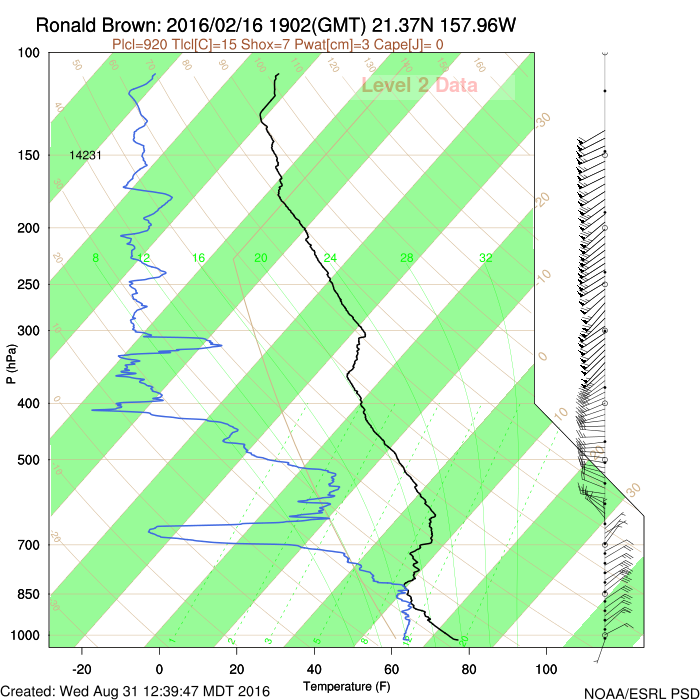
Scientists aboard the NOAA Ship Ronald H. Brown launched radiosondes up to 8 times per day during the Tropical Atmosphere Ocean (TAO) survey cruise along 140°W and 125°W from February 16 to March 18, 2016. |
|
||||||||

Radiosonde [GET]
|
Surface Meteorology [GET]Dates:20160216-20160316Times:Every 1 minute.Spatial Coverage:Cruise was in box 8S-28.4N; 158W-119W.VariablesPressure, temperature, relative humidity, winds, sea surface temperature, downwelling shortwave radiation, latitude, longitude, ship course over ground, ship heading, ship speed over ground.Instruments:Vaisala PTB330 barometer, Rotronic MP101A humidity and temperature probe, Vaisala WMT700 ultrasonic anemometers, SBE 45 MicroTSG Thermosalinograph, Eppley PSP pyranometerFormat:NASA-Ames format ASCII files (format description).Data Issues:Data have been been corrected for known measurement issues when possible and replaced with bad/missing flags when that was not possible, and have been visually screened for physically unreasonable values. See the metadata in the file header for basic details and contact information.Citation:Please cite ESRL/PSL if using this data as the source let us know if you are using this data in your research. A dataset DOI is in process, please email contact(s) to get the latest information. A dataset DOI is in process, please email contact(s) to get the latest information. Journal articles documenting the dataset are in process, please email contact(s) to get the latest information.DOI:10.7289/V5SF2T80.Contacts:psl.data@noaa.gov, Christopher.J.Cox@noaa.govISO metadata:From NOAA/NCEI. |
Conductivity, temperature, and depth (CTD) ocean sonde data [GET]
|

Surface Flux Measurements (processed) [GET]
|

Ocean Measurements (standard) [GET]Dates:20160216-20160317Times:Every 1 minute.Spatial Coverage:Cruise was in box 8S-28.4N; 158W-119W.VariablesAir temperature, barometric pressure, conductivity, hydrostatic pressure, precipitation amount, precipitation, relative humidity, salinity, shortwave radiation - reflected, sound velocity, water temperature, wind direction, wind speed, water depthInstruments:Thermosalinograph (TSG),Acoustic Doppler Current Profiler (ADCP),Multibeam Mapping, CTD, Argo Floats, drifter buoys.Format:VariesData Issues:None known.Citation:Please cite NOAA if using this data as the source. See metadata link.DOI:unknown. Accession number is 155888.Contacts:NODC.DataOfficer@noaa.govData page:From NOAA/NCEI.Iso Metadata:From NOAA/NCEI. ' |
Global Hawk |
|||||||
 |
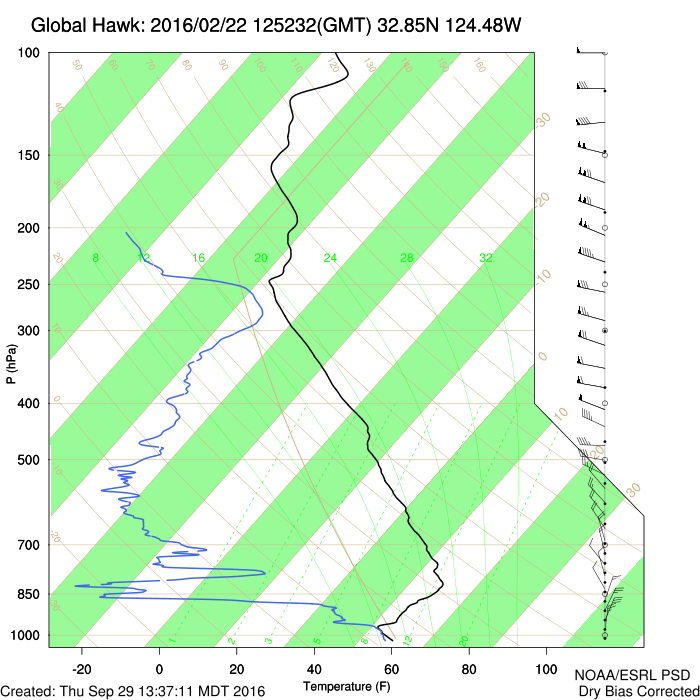
The Sensing Hazards with Operational Unmanned Technology (SHOUT) project led by the NOAA Unmanned Aircraft System (UAS) Program, deployed the NASA Global Hawk UAS carrying a suite of meteorological sensors and deploying dropsondes during three research flights in February. Read more about the dropsonde system...
|
|
|||||
Dropsondes [GET]
|
Ozone [GET]Dates:20160212, 20160215, and 20160221.Times:continuousSpatial Coverage:Flight pathInstrument:UV absorption instrument for measurement of ozone.Format:NASA's ICARTT V1.1 format.Units:Ozone volumetric mixing ratio reported in parts per billion (ppbv). 2 Hz data. time is UTC_s, seconds since midnight on flight start day.Data Issues:Data available for use; contact PI for more information if desired.Citation:Please cite ESRL/CSD if using this data as the source let us know if you are using this data in your research.Contacts:Address: Troy Thornberry, 325 Broadway R/CSD6, Boulder, CO 80305; e-mail: troy.thornberry@noaa.gov; phone: 303-497-3373. For issues with link: psl.data@noaa.gov .ISO metadata:Coming Soon! |
High Altitude MMIC Sounding Radiometer (HAMSR) [GET]
|

Santa Clara X-band Radar |
|||||||
 |
Owned and operated by NOAA's Cooperative Institute for Research in the Atmosphere, the X-Band observed skies over Santa Clara, California through the end of April. It will augment NEXRAD, a network of 160 Doppler weather radars operated by the National Weather Service in the Bay area. Its purpose is to determine how rainfall estimates and short-term predictions can be improved. |
|
|||||
X-Band Radar
|

Auxiliary Data and Information |
||
 |
Datasets listed on this page were not created exclusively for ENRR but are useful for the project. They may supply information relating to ENSO impacts or they may be located in the ENRR region. |
|
Satellite Retrievals [GET]
Dates:20160121 – 20160310 (matching the G-IV flight days)Spatial Coverage:areal extent: 180W-120W; 1S-38N (map of flight paths)Variables:Skin temperature, vertical Temperature profiles, saturation specific humidity,relative humidity,dewpoint, CO2, CO, CH4, N2O, and HNO3.FORMATASCII FilesCitationGambacorta A. (2013), The NOAA Unique CrIS ATMS Processing System, (NUCAPS) Algorithm Theoretical Basis (ATBD).Gambacorta, A., C. Barnet, and M. Goldberg, Status of the NOAA Unique CrIS/ATMS Processing System (NUCAPS), 2015: Algorithm development and lessons learned from recent field campaigns, in Proceedings of ITSC-20, International TOVS Working Group (ITWG), Lake Geneva, Wisconsin, USA. Nalli, N.R., C.D. Barnet, A. Reale, D. Tobin, A. Gabacorta, E.S. Maddy, E. Joseph, B. Sun, L. Borg, A.K. Mollner, V.R. Morris, X. Liu, M. Divakarala, P.J. Minnett, R.O. Knuteson, T.S. King and W.W. Wolf, 2013: Validation of satellite sounder environmental data records: Application to the Cross-track Infrared Microwave Sounder Suite, J. Geophys. Res. Atmos., 118, 13,628–13,643, doi:10.1002/2013JD020436. Contactspsl.data@noaa.govISO MetadataComing SoonCodeSample NCL code to read/plot single drop files.Notes
|

C-130 Aircraft Data [GET]
Data is available from the PSL web site Data is in FRD format. There is a dry bias corrected version (see UCAR technical note). To cite: When referencing the NSF/NCAR Hercules C130 Aircraft in publications or proposals, please use the identifier 10.5065/D6WM1BG0 -- for example as a citation: UCAR/NCAR - Earth Observing Laboratory. (1994). NSF/NCAR Hercules C130 Aircraft. UCAR/NCAR - Earth Observing Laboratory. https://doi.org/10.5065/D6WM1BG0 Retrieved December 20, 2016 from NOAA/ESRL PSL from their website https://psl.noaa.gov/enso/rapid_response/data_pub/. |

HMT-West
More information on HMT including access to data during the ENRR campaign can be found on the Hydrometeorology Testbed (HMT) website. |

TOGA-COARE Historic Wind Profiler data
|

Location of ENRR Dropsondes and Raobs
|

TOGA-TAO: Tropical Moored Buoy Array
|

North Pacific Analyses during ENRR
|


Satellite Archives
|
Disclaimer:Every effort is made to assure that the values are correct. However, no guarantees are made and NOAA does is not liable for direct, indirect, incidental, consequential, special or exemplary damages or lost profit resulting from any use or misuse of this data. Researchers should carefully read all data documentation.
|